

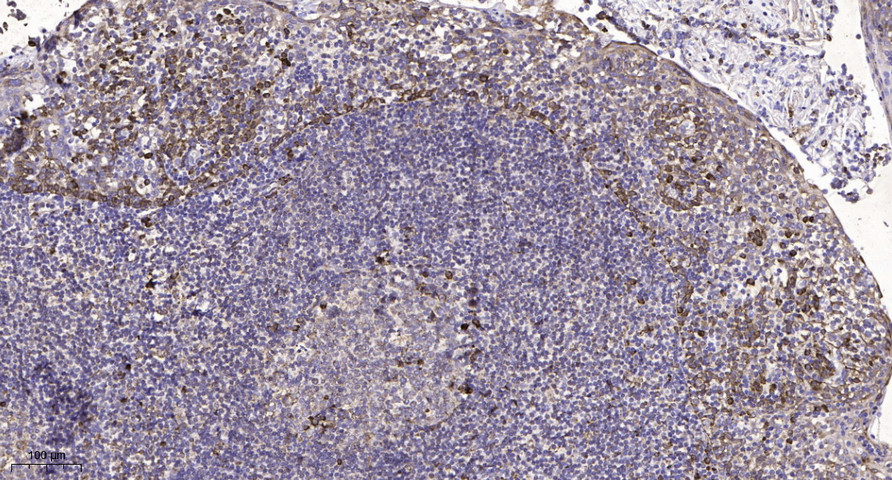
Main InformationTargetSCN1AHost SpeciesRabbitReactivityHuman, Mouse, RatApplicationsWB, IHC, IF, ELISAMW220kD (Observed)Conjugate/ModificationUnmodifiedDetailed InformationRecommended Dilution RatioWB 1:500-1:2000; IHC 1:100-1:300; IF 1:200-1:1000; ELISA 1:40000; Not yet tested in other applications.FormulationLiquid in PBS containing 50% glycerol, 0.5% BSA and 0.02% sodium azide.SpecificityThis antibody detects endogenous levels of human SCN1APurificationThe antibody was affinity-purified from rabbit antiserum by affinity-chromatography using epitope-specific immunogen.Storage-15°C to -25°C/1 year(Do not lower than -25°C)Concentration1 mg/mlMW(Observed)220kDModificationUnmodifiedClonalityPolyclonalIsotypeIgGAntigen&Target InformationImmunogen:Synthesized peptide derived from human SCN1ASpecificity:This antibody detects endogenous levels of human SCN1AGene Name:SCN1A NAC1 SCN1Protein Name:SCN1AOther Name:Sodium channel protein type 1 subunit alpha ; Sodium channel protein brain I subunit alpha ; Sodium channel protein type I subunit alpha ; Voltage-gated sodium channel subunit alpha Nav1.1 ;Background:Voltage-dependent sodium channels are heteromeric complexes that regulate sodium exchange between intracellular and extracellular spaces and are essential for the generation and propagation of action potentials in muscle cells and neurons. Each sodium channel is composed of a large pore-forming, glycosylated alpha subunit and two smaller beta subunits. This gene encodes a sodium channel alpha subunit, which has four homologous domains, each of which contains six transmembrane regions. Allelic variants of this gene are associated with generalized epilepsy with febrile seizures and epileptic encephalopathy. Alternative splicing results in multiple transcript variants. The RefSeq Project has decided to create four representative RefSeq records. Three of the transcript variants are supported by experimental evidence and the fourth contains alternate 5' untranslated exons, thFunction:Disease:Defects in SCN1A are a cause of intractable childhood epilepsy with generalized tonic-clonic seizures (ICEGTC) [MIM:607208]. ICEGTC is a disorder characterized by generalized tonic-clonic seizures beginning usually in infancy and induced by fever. Seizures are associated with subsequent mental decline, as well as ataxia or hypotonia. ICEGTC is similar to SMEI, except for the absence of myoclonic seizures.,Disease:Defects in SCN1A are a cause of severe myoclonic epilepsy in infancy (SMEI) [MIM:607208]; also called Dravet syndrome. SMEI is a rare disorder characterized by generalized tonic, clonic, and tonic-clonic seizures that are initially induced by fever and begin during the first year of life. Later, patients also manifest other seizure types, including absence, myoclonic, and simple and complex partial seizures. Psychomotor development delay is observed around the second year of life. SMEI is considered to be the most severe phenotype within the spectrum of generalized epilepsies with febrile seizures-plus.,Disease:Defects in SCN1A are the cause of familial febrile convulsions type 3 (FEB3) [MIM:604403]; also known as familial febrile seizures 3. Febrile convulsions are seizures associated with febrile episodes in childhood without any evidence of intracranial infection or defined pathologic or traumatic cause. It is a common condition, affecting 2-5% of children aged 3 months to 5 years. The majority are simple febrile seizures (generally defined as generalized onset, single seizures with a duration of less than 30 minutes). Complex febrile seizures are characterized by focal onset, duration greater than 30 minutes, and/or more than one seizure in a 24 hour period. The likelihood of developing epilepsy following simple febrile seizures is low. Complex febrile seizures are associated with a moderately increased incidence of epilepsy.,Disease:Defects in SCN1A are the cause of familial hemiplegic migraine type 3 (FHM3) [MIM:609634]. FHM3 is an autosomal dominant severe subtype of migraine with aura characterized by some degree of hemiparesis during the attacks. The episodes are associated with variable features of nausea, vomiting, photophobia, and phonophobia. Age at onset ranges from 6 to 15 years. FHM is occasionally associated with other neurologic symptoms such as cerebellar ataxia or epileptic seizures. A unique eye phenotype of elicited repetitive daily blindness has also been reported to be cosegregating with FHM in a single Swiss family.,Disease:Defects in SCN1A are the cause of generalized epilepsy with febrile seizures plus type 2 (GEFS+2) [MIM:604233]. Generalized epilepsy with febrile seizures-plus refers to a rare autosomal dominant, familial condition with incomplete penetrance and large intrafamilial variability. Patients display febrile seizures persisting sometimes beyond the age of 6 years and/or a variety of afebrile seizure types. GEFS+ is a disease combining febrile seizures, generalized seizures often precipitated by fever at age 6 years or more, and partial seizures, with a variable degree of severity.,Domain:The sequence contains 4 internal repeats, each with 5 hydrophobic segments (S1,S2,S3,S5,S6) and one positively charged segment (S4). Segments S4 are probably the voltage-sensors and are characterized by a series of positively charged amino acids at every third position.,Function:Mediates the voltage-dependent sodium ion permeability of excitable membranes. Assuming opened or closed conformations in response to the voltage difference across the membrane, the protein forms a sodium-selective channel through which Na(+) ions may pass in accordance with their electrochemical gradient.,similarity:Belongs to the sodium channel family.,similarity:Contains 1 IQ domain.,subunit:The sodium channel consists of a large polypeptide and 2-3 smaller ones. This sequence represents a large polypeptide.,Cellular Localization:Cell membrane ; Multi-pass membrane protein .Tissue Expression:Brain,Normal brain,Research Areas:>>Dopaminergic synapse
商品信息已成功复制,启研竭诚为您服务


