

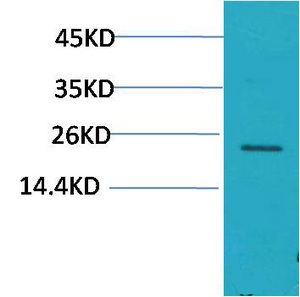
Main InformationTargetHSPB8Host SpeciesRabbitReactivityHumanApplicationsWBMW22kD (Observed)Conjugate/ModificationUnmodifiedDetailed InformationRecommended Dilution RatioWB 1:500-1000FormulationPBS, pH 7.4, containing 0.5%BSA, 0.02% sodium azide as Preservative and 50% Glycerol.SpecificityThe antibody detects endogenous Crystallin-αC protein.PurificationThe antibody was affinity-purified from rabbit antiserum by affinity-chromatography using epitope-specific immunogen.Storage-15°C to -25°C/1 year(Do not lower than -25°C)MW(Observed)22kDModificationUnmodifiedClonalityPolyclonalIsotypeIgGAntigen&Target InformationImmunogen:Recombinant Protein of Crystallin-αCSpecificity:The antibody detects endogenous Crystallin-αC protein.Gene Name:HSPB8Protein Name:Heat shock protein beta-8Other Name:HSPB8 ; CRYAC ; E2IG1 ; HSP22 ; PP1629 ; Heat shock protein beta-8 ; HspB8 ; Alpha-crystallin C chain ; E2-induced gene 1 protein ; Protein kinase H11 ; Small stress protein-like protein HSP22Background:The protein encoded by this gene belongs to the superfamily of small heat-shock proteins containing a conservative alpha-crystallin domain at the C-terminal part of the molecule. The expression of this gene in induced by estrogen in estrogen receptor-positive breast cancer cells, and this protein also functions as a chaperone in association with Bag3, a stimulator of macroautophagy. Thus, this gene appears to be involved in regulation of cell proliferation, apoptosis, and carcinogenesis, and mutations in this gene have been associated with different neuromuscular diseases, including Charcot-Marie-Tooth disease. [provided by RefSeq, Jul 2008],Function:Caution:Was reported (PubMed:10833516) to have a protein kinase activity and to act as a Mn(2+)-dependent serine-threonine-specific protein kinase.,Disease:Defects in HSPB8 are the cause of Charcot-Marie-Tooth disease type 2L (CMT2L) [MIM:608673]. CMT2L is an axonal form of Charcot-Marie-Tooth disease. Axonal CMT neuropathies are characterized by signs of axonal regeneration in the absence of obvious myelin alterations, normal or slightly reduced nerve conduction velocities, and progressive distal muscle weakness and atrophy.,Disease:Defects in HSPB8 are the cause of distal hereditary motor neuronopathy type 2A (HMN2A) [MIM:158590]; also known as distal hereditary motor neuropathy type IIA or spinal Charcot-Marie-Tooth disease IIA. Distal hereditary motor neuronopathies constitute a heterogeneous group of neuromuscular disorders caused by selective impairment of motor neurons in the anterior horn of the spinal cord, without sensory deficit in the posterior horn. The overall clinical picture consists of a classical distal muscular atrophy syndrome in the legs without clinical sensory loss. The disease starts with weakness and wasting of distal muscles of the anterior tibial and peroneal compartments of the legs. Later on, weakness and atrophy may expand to the proximal muscles of the lower limbs and/or to the distal upper limbs.,Function:Displays temperature-dependent chaperone activity.,induction:By 17-beta-estradiol.,PTM:Phosphorylated.,similarity:Belongs to the small heat shock protein (HSP20) family.,subunit:Monomer. Interacts with HSPB1.,tissue specificity:Predominantly expressed in skeletal muscle and heart.,Cellular Localization:Cytoplasm . Nucleus . Translocates to nuclear foci during heat shock.Tissue Expression:Predominantly expressed in skeletal muscle and heart.
商品信息已成功复制,启研竭诚为您服务


