

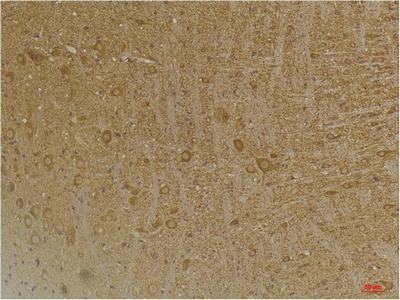
Main InformationTargetGABBR2Host SpeciesRabbitReactivityHuman, Rat, MouseApplicationsIHC, IFMW106kD (Observed)Conjugate/ModificationUnmodifiedDetailed InformationRecommended Dilution RatioIHC 1:100-200; IF 1:50-200FormulationLiquid in PBS containing 50% glycerol, 0.5% BSA and 0.02% sodium azide.SpecificityGABA B Receptor 2 protein(A228) detects endogenous levels of GABA B Receptor 2PurificationThe antibody was affinity-purified from rabbit antiserum by affinity-chromatography using epitope-specific immunogen.Storage-15°C to -25°C/1 year(Do not lower than -25°C)Concentration1 mg/mlMW(Observed)106kDModificationUnmodifiedClonalityPolyclonalIsotypeIgGAntigen&Target InformationImmunogen:Synthetic Peptide of GABA B Receptor 2 AA range: 785-835Specificity:GABA B Receptor 2 protein(A228) detects endogenous levels of GABA B Receptor 2Gene Name:GABBR2Protein Name:Gamma-aminobutyric acid type B receptor subunit 2 (GABA-B receptor 2) (GABA-B-R2) (GABA-BR2) (GABABR2) (Gb2) (G-protein coupled receptor 51) (HG20)Other Name:GABBR2 ; GPR51 ; GPRC3B ; Gamma-aminobutyric acid type B receptor subunit 2 ; GABA-B receptor 2 ; GABA-B-R2 ; GABA-BR2 ; GABABR2 ; Gb2 ; G-protein coupled receptor 51 ; HG20Background:The multi-pass membrane protein encoded by this gene belongs to the G-protein coupled receptor 3 family and GABA-B receptor subfamily. The GABA-B receptors inhibit neuronal activity through G protein-coupled second-messenger systems, which regulate the release of neurotransmitters, and the activity of ion channels and adenylyl cyclase. This receptor subunit forms an active heterodimeric complex with GABA-B receptor subunit 1, neither of which is effective on its own. Allelic variants of this gene have been associated with nicotine dependence.[provided by RefSeq, Jan 2010],Function:Domain:Alpha-helical parts of the C-terminal intracellular region mediate heterodimeric interaction with GABA-B receptor 1.,Function:Receptor for GABA. The activity of this receptor is mediated by G-proteins that inhibit adenylyl cyclase activity, stimulates phospholipase A2, activates potassium channels, inactivates voltage-dependent calcium-channels and modulates inositol phospholipids hydrolysis. Plays a critical role in the fine-tuning of inhibitory synaptic transmission. Pre-synaptic GABA-B-R inhibit neurotransmitter release by down-regulating high-voltage activated calcium channels, whereas postsynaptic GABA-B-R decrease neuronal excitability by activating a prominent inwardly rectifying potassium (Kir) conductance that underlies the late inhibitory postsynaptic potentials. Not only implicated in synaptic inhibition but also in hippocampal long-term potentiation, slow wave sleep, muscle relaxation and antinociception.,similarity:Belongs to the G-protein coupled receptor 3 family. GABA-B receptor subfamily.,subcellular location:Moreover coexpression of GABA-B-R1 and GABA-B-R2 appears to be a prerequisite for maturation and transport of GABA-B-R1 to the plasma membrane.,subunit:Heterodimer of GABA-B-R1 and GABA-B-R2. Neither of which is effective on its own and homodimeric assembly does not seem to happen. Interacts with ATF4 via its C-terminal region.,tissue specificity:Highly expressed in brain, especially in cerebral cortex, thalamus, hippocampus, frontal, occipital and temporal lobe, occipital pole and cerebellum, followed by corpus callosum, caudate nucleus, spinal cord, amygdala and medulla. Weakly expressed in heart, testis and skeletal muscle.,Cellular Localization:Cell membrane ; Multi-pass membrane protein . Cell junction, synapse, postsynaptic cell membrane ; Multi-pass membrane protein . Coexpression of GABBR1 and GABBR2 is required for GABBR1 maturation and transport to the plasma membrane. In contrast, GABBR2 does not depend on GABBR1 for transport to the cell membrane. .Tissue Expression:Highly expressed in brain, especially in cerebral cortex, thalamus, hippocampus, frontal, occipital and temporal lobe, occipital pole and cerebellum, followed by corpus callosum, caudate nucleus, spinal cord, amygdala and medulla (PubMed:10087195, PubMed:10328880, PubMed:10727622, PubMed:9872744). Weakly expressed in heart, testis and skeletal muscle (PubMed:10087195, PubMed:10727622).Research Areas:>>cAMP signaling pathway ; >>Neuroactive ligand-receptor interaction ; >>GABAergic synapse ; >>Taste transduction ; >>Estrogen signaling pathway ; >>GnRH secretion ; >>Morphine addiction
商品信息已成功复制,启研竭诚为您服务


