

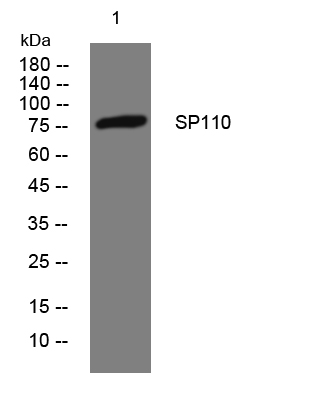
Main InformationTargetSP110Host SpeciesRabbitReactivityHuman, Mouse, RatApplicationsWBMW76kD (Calculated)Conjugate/ModificationUnmodifiedDetailed InformationRecommended Dilution RatioWB 1:500-2000FormulationLiquid in PBS containing 50% glycerol, 0.5% BSA and 0.02% sodium azide.SpecificityThis antibody detects endogenous levels of SP110 at Human/Mouse/RatPurificationThe antibody was affinity-purified from rabbit antiserum by affinity-chromatography using epitope-specific immunogen.Storage-15°C to -25°C/1 year(Do not lower than -25°C)Concentration1 mg/mlMW(Calculated)76kDModificationUnmodifiedClonalityPolyclonalIsotypeIgGAntigen&Target InformationImmunogen:Synthesized peptide derived from human SP110 AA range: 453-503Specificity:This antibody detects endogenous levels of SP110 at Human/Mouse/RatGene Name:SP110Protein Name:SP110Database Link:Background:The nuclear body is a multiprotein complex that may have a role in the regulation of gene transcription. This gene is a member of the SP100/SP140 family of nuclear body proteins and encodes a leukocyte-specific nuclear body component. The protein can function as an activator of gene transcription and may serve as a nuclear hormone receptor coactivator. In addition, it has been suggested that the protein may play a role in ribosome biogenesis and in the induction of myeloid cell differentiation. Alternative splicing has been observed for this gene and three transcript variants, encoding distinct isoforms, have been identified. [provided by RefSeq, Jul 2008],Function:Disease:Defects in SP110 are the cause of hepatic venoocclusive disease with immunodeficiency (VODI) [MIM:235550]. VODI is an autosomal recessive primary immunodeficiency associated with hepatic vascular occlusion and fibrosis. The immunodeficiency is characterized by severe hypogammaglobulinemia, combined T and B cell immunodeficiency, absent lymph node germinal centers, and absent tissue plasma cells.,Function:Transcription factor. May be a nuclear hormone receptor coactivator. Enhances transcription of genes with retinoic acid response elements (RARE).,induction:By interferon gamma and by all-trans retinoic acid.,online information:SP110 mutation db,PTM:Phosphorylated (isoform 2).,similarity:Contains 1 bromo domain.,similarity:Contains 1 HSR domain.,similarity:Contains 1 PHD-type zinc finger.,similarity:Contains 1 SAND domain.,subcellular location:Found in the nuclear body.,subunit:Isoform 3 interacts with HCV core protein.,tissue specificity:Highly expressed in peripheral blood leukocytes and spleen. Detected at intermediate levels in thymus, prostate, testis, ovary, small intestine and colon, and at low levels in heart, brain, placenta, lung, liver, skeletal muscle, kidney and pancreas.,Cellular Localization:Nucleus . Found in the nuclear body.Tissue Expression:Highly expressed in peripheral blood leukocytes and spleen. Detected at intermediate levels in thymus, prostate, testis, ovary, small intestine and colon, and at low levels in heart, brain, placenta, lung, liver, skeletal muscle, kidney and pancreas.
商品信息已成功复制,启研竭诚为您服务


