

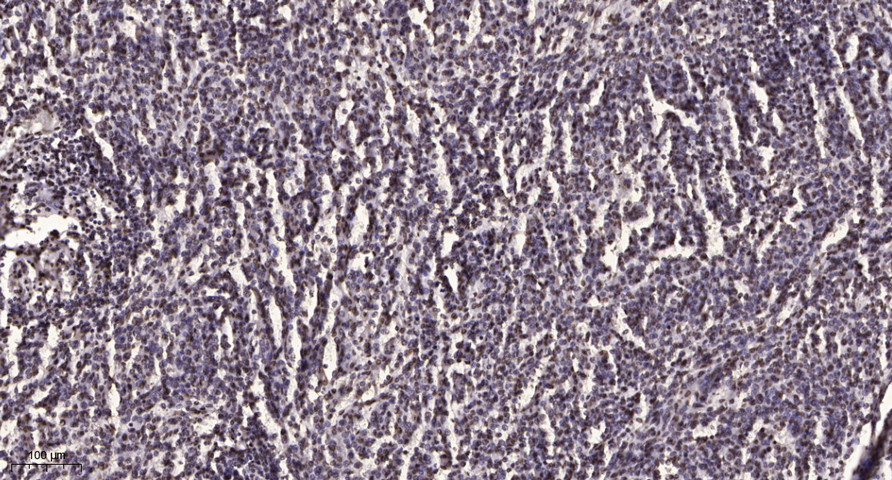
Main InformationTargetITKHost SpeciesRabbitReactivityHuman, MouseApplicationsIHC, IF, WBMW72kD (Observed)Conjugate/ModificationUnmodifiedDetailed InformationRecommended Dilution RatioIHC 1:50-200; WB 1:500-2000; IF 1:50-200FormulationLiquid in PBS containing 50% glycerol, 0.5% BSA and 0.02% sodium azide.SpecificityThis antibody detects endogenous levels of human ITKPurificationThe antibody was affinity-purified from rabbit antiserum by affinity-chromatography using epitope-specific immunogen.Storage-15°C to -25°C/1 year(Do not lower than -25°C)Concentration1 mg/mlMW(Observed)72kDModificationUnmodifiedClonalityPolyclonalIsotypeIgGAntigen&Target InformationImmunogen:Synthesized peptide derived from human ITK AA range: 450-530Specificity:This antibody detects endogenous levels of human ITKGene Name:ITK EMT LYKProtein Name:ITKOther Name:Tyrosine-protein kinase ITK/TSK ; Interleukin-2-inducible T-cell kinase ; IL-2-inducible T-cell kinase ; Kinase EMT ; T-cell-specific kinase ; Tyrosine-protein kinase Lyk ;Background:This gene encodes an intracellular tyrosine kinase expressed in T-cells. The protein contains both SH2 and SH3 domains which are often found in intracellular kinases. It is thought to play a role in T-cell proliferation and differentiation. [provided by RefSeq, Jul 2008],Function:Catalytic activity:ATP + a [protein]-L-tyrosine = ADP + a [protein]-L-tyrosine phosphate.,cofactor:Binds 1 zinc ion per subunit.,Function:Plays a role in T-cell proliferation and differentiation.,induction:By interleukin-2.,similarity:Belongs to the protein kinase superfamily. Tyr protein kinase family. TEC subfamily.,similarity:Contains 1 Btk-type zinc finger.,similarity:Contains 1 PH domain.,similarity:Contains 1 protein kinase domain.,similarity:Contains 1 SH2 domain.,similarity:Contains 1 SH3 domain.,subcellular location:Localizes to cell surface receptors in the plasma membrane after stimulation with respective receptors (TCR, CD28, CD2) in T-cells.,tissue specificity:T-cell lines and natural killer cell lines.,Cellular Localization:Cytoplasm . Nucleus . Localizes in the vicinity of cell surface receptors in the plasma membrane after receptor stimulation.Tissue Expression:T-cell lines and natural killer cell lines.Research Areas:>>Chemokine signaling pathway ; >>T cell receptor signaling pathway ; >>Leukocyte transendothelial migration
商品信息已成功复制,启研竭诚为您服务


