

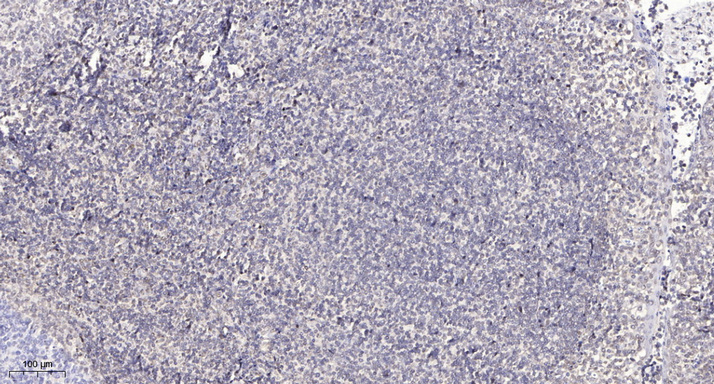
Main InformationTargetCyclin T2Host SpeciesRabbitReactivityHuman, Mouse, RatApplicationsIHC, IF, WBMW73kD (Observed)Conjugate/ModificationUnmodifiedDetailed InformationRecommended Dilution RatioIHC 1:50-200; WB 1:500-2000; IF 1:50-200FormulationLiquid in PBS containing 50% glycerol, 0.5% BSA and 0.02% sodium azide.SpecificityThis antibody detects endogenous levels of human Cyclin T2PurificationThe antibody was affinity-purified from rabbit antiserum by affinity-chromatography using epitope-specific immunogen.Storage-15°C to -25°C/1 year(Do not lower than -25°C)Concentration1 mg/mlMW(Observed)73kDModificationUnmodifiedClonalityPolyclonalIsotypeIgGAntigen&Target InformationImmunogen:Synthesized peptide derived from human Cyclin T2 AA range: 510-590Specificity:This antibody detects endogenous levels of human Cyclin T2Gene Name:CCNT2Protein Name:Cyclin T2Other Name:Cyclin-T2 ; CycT2 ;Background:The protein encoded by this gene belongs to the highly conserved cyclin family, whose members are characterized by a dramatic periodicity in protein abundance through the cell cycle. Cyclins function as regulators of CDK kinases. Different cyclins exhibit distinct expression and degradation patterns which contribute to the temporal coordination of each mitotic event. This cyclin and its kinase partner CDK9 were found to be subunits of the transcription elongation factor p-TEFb. The p-TEFb complex containing this cyclin was reported to interact with, and act as a negative regulator of human immunodeficiency virus type 1 (HIV-1) Tat protein. A pseudogene of this gene is found on chromosome 1. Alternate splicing results in multiple transcript variants.[provided by RefSeq, Dec 2010],Function:Function:Regulatory subunit of the cyclin-dependent kinase pair (CDK9/cyclin T) complex, also called positive transcription elongation factor B (P-TEFb), which is proposed to facilitate the transition from abortive to production elongation by phosphorylating the CTD (carboxy-terminal domain) of the large subunit of RNA polymerase II (RNAP II).,similarity:Belongs to the cyclin family. Cyclin C subfamily.,subunit:Associates with CDK9 to form P-TEFb. Isoform A and isoform B interact with HIV-2 and SIV Tat. Does not bind efficiently to the transactivation domain of the HIV-1 Tat.,tissue specificity:Ubiquitously expressed.,Cellular Localization:Cytoplasm, perinuclear region . Nucleus . Nucleus in differentiating cells. .Tissue Expression:Ubiquitously expressed.Research Areas:>>Viral life cycle - HIV-1 ; >>Transcriptional misregulation in cancer
商品信息已成功复制,启研竭诚为您服务


