

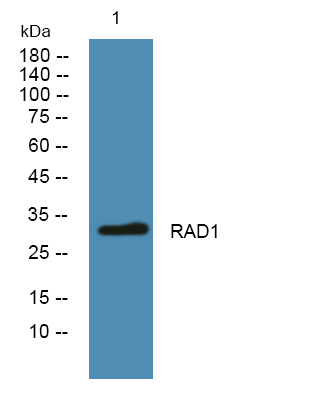
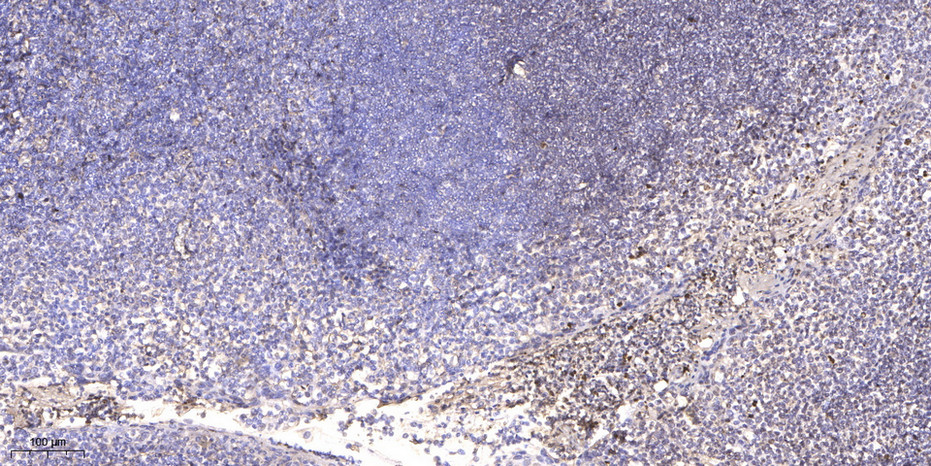
Main InformationTargetRAD1Host SpeciesRabbitReactivityHuman, MouseApplicationsIHC, IF, WBMW32kD (Observed)Conjugate/ModificationUnmodifiedDetailed InformationRecommended Dilution RatioIHC 1:50-200; WB 1:500-2000; IF 1:50-200FormulationLiquid in PBS containing 50% glycerol, 0.5% BSA and 0.02% sodium azide.SpecificityThis antibody detects endogenous levels of human RAD1PurificationThe antibody was affinity-purified from rabbit antiserum by affinity-chromatography using epitope-specific immunogen.Storage-15°C to -25°C/1 year(Do not lower than -25°C)Concentration1 mg/mlMW(Observed)32kDModificationUnmodifiedClonalityPolyclonalIsotypeIgGAntigen&Target InformationImmunogen:Synthesized peptide derived from human RAD1Specificity:This antibody detects endogenous levels of human RAD1Gene Name:RAD1 REC1Protein Name:RAD1Other Name:Cell cycle checkpoint protein RAD1 ; hRAD1 ; DNA repair exonuclease rad1 homolog ; Rad1-like DNA damage checkpoint protein ;Background:This gene encodes a component of a heterotrimeric cell cycle checkpoint complex, known as the 9-1-1 complex, that is activated to stop cell cycle progression in response to DNA damage or incomplete DNA replication. The 9-1-1 complex is recruited by RAD17 to affected sites where it may attract specialized DNA polymerases and other DNA repair effectors. Alternatively spliced transcript variants of this gene have been described. [provided by RefSeq, Jan 2009],Function:Catalytic activity:Exonucleolytic cleavage in the 3'- to 5'-direction to yield nucleoside 5'-phosphates.,Function:Component of the 9-1-1 cell-cycle checkpoint response complex that plays a major role in DNA repair. The 9-1-1 complex is recruited to DNA lesion upon damage by the RAD17-replication factor C (RFC) clamp loader complex. Acts then as a sliding clamp platform on DNA for several proteins involved in long-patch base excision repair (LP-BER). The 9-1-1 complex stimulates DNA polymerase beta (POLB) activity by increasing its affinity for the 3'-OH end of the primer-template and stabilizes POLB to those sites where LP-BER proceeds; endonuclease FEN1 cleavage activity on substrates with double, nick, or gap flaps of distinct sequences and lengths; and DNA ligase I (LIG1) on long-patch base excision repair substrates. Isoform 1 possesses 3'->5' double stranded DNA exonuclease activity.,similarity:Belongs to the rad1 family.,subunit:Component of the toroidal 9-1-1 (RAD9-RAD1-HUS1) complex, composed of RAD9A, RAD1 and HUS1. The 9-1-1 complex associates with LIG1, POLB, FEN1, RAD17, HDAC1, RPA1 and RPA2. The 9-1-1 complex associates with the RAD17-RFC complex. RAD1 interacts with POLB, FEN1, HUS1, HUS1B, RAD9A and RAD9B.,tissue specificity:Expressed in testis, uterus, bladder, spleen, ovaries, lung, brain and muscle (at protein level).,Cellular Localization:Nucleus .Tissue Expression:Expressed in testis, uterus, bladder, spleen, ovaries, lung, brain and muscle (at protein level).Research Areas:>>Cellular senescence
商品信息已成功复制,启研竭诚为您服务


