

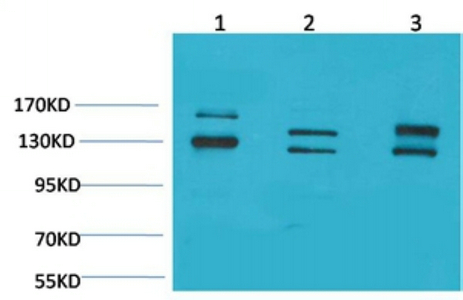
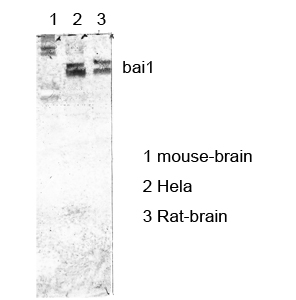
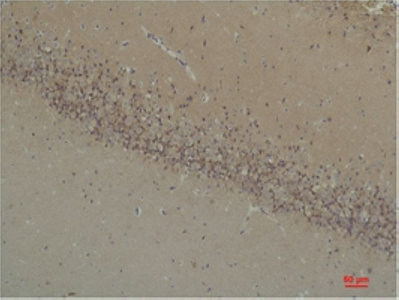
Main InformationTargetBAI1Host SpeciesRabbitReactivityHuman, Rat, MouseApplicationsWB, IHC, IFMW130-170kD (Observed)Conjugate/ModificationUnmodifiedDetailed InformationRecommended Dilution RatioWB 1:500-1:2000; IHC 1:100-1:300; ELISA 1:40000; IF 1:50-200FormulationLiquid in PBS containing 50% glycerol, 0.5% BSA and 0.02% sodium azide.SpecificityThe antibody detects endogenous BAI1 proteinPurificationThe antibody was affinity-purified from rabbit antiserum by affinity-chromatography using epitope-specific immunogen.Storage-15°C to -25°C/1 year(Do not lower than -25°C)Concentration1 mg/mlMW(Observed)130-170kDModificationUnmodifiedClonalityPolyclonalIsotypeIgGAntigen&Target InformationImmunogen:Synthetic Peptide of BAI1 AA range: 101-151Specificity:The antibody detects endogenous BAI1 proteinGene Name:BAI1Protein Name:Brain-specific angiogenesis inhibitor 1Other Name:Brain-specific angiogenesis inhibitor 1Background:Angiogenesis is controlled by a local balance between stimulators and inhibitors of new vessel growth and is suppressed under normal physiologic conditions. Angiogenesis has been shown to be essential for growth and metastasis of solid tumors. In order to obtain blood supply for their growth, tumor cells are potently angiogenic and attract new vessels as results of increased secretion of inducers and decreased production of endogenous negative regulators. BAI1 contains at least one 'functional' p53-binding site within an intron, and its expression has been shown to be induced by wildtype p53. There are two other brain-specific angiogenesis inhibitor genes, designated BAI2 and BAI3 which along with BAI1 have similar tissue specificities and structures, however only BAI1 is transcriptionally regulated by p53. BAI1 is postulated to be a member of the secretin receptor family,Function:Domain:The TSP1 repeats inhibit in vivo angiogenesis in rat cornea induced by BFGF.,Function:Phosphatidylserine receptor that enhances the engulfment of apoptotic cells. Likely to be a potent inhibitor of angiogenesis in brain and may play a significant role as a mediator of the p53 signal in suppression of glioblastoma. May function in cell adhesion and signal transduction in the brain.,induction:By p53.,similarity:Belongs to the G-protein coupled receptor 2 family. LN-TM7 subfamily.,similarity:Contains 1 GPS domain.,similarity:Contains 5 TSP type-1 domains.,subcellular location:Likely to be concentrated at cell-cell adhesion sites.,subunit:Interacts with ELMO1 and DOCK1. When bound to ELMO1 and DOCK1, it may act as a module to promote the engulfment (By similarity). Interacts with MAGI1, MAGI3, BAIAP2 and PHYHIP.,tissue specificity:Specifically expressed in brain. Reduced or no expression is observed in some glioblastoma cell lines and cancer tissues. No expression in astrocytes.,Cellular Localization:Cell membrane ; Multi-pass membrane protein . Cell projection, phagocytic cup . Cell junction, focal adhesion . Cell projection, dendritic spine . Cell junction, synapse, postsynaptic density .; [Vasculostatin-120]: Secreted .; [Vasculostatin-40]: Secreted .Tissue Expression:Expressed in brain (at protein level) (PubMed:12074842, PubMed:12507886). Expressed on mononuclear phagocytes and monocyte-derived macrophages in the gastric mucosa (at protein level) (PubMed:24509909). Expressed in normal pancreatic tissue but not in pancreatic tumor tissue (PubMed:11875720). Reduced or no expression is observed in some glioblastomas (PubMed:12507886).Research Areas:>>p53 signaling pathway
商品信息已成功复制,启研竭诚为您服务


