

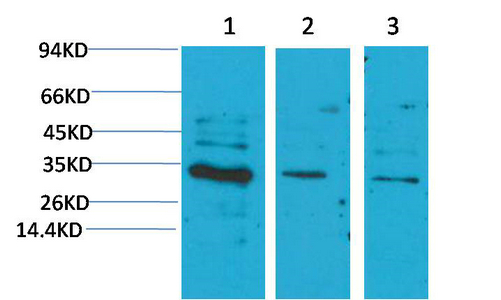
Main InformationTargetCNTFHost SpeciesRabbitReactivityHuman, Rat, MouseApplicationsWBMW30kD (Observed)Conjugate/ModificationUnmodifiedDetailed InformationRecommended Dilution RatioWB 1:500-1000FormulationLiquid in PBS containing 50% glycerol, 0.5% BSA and 0.02% sodium azide.SpecificityCNTF protein(A218) detects endogenous levels of CNTFPurificationThe antibody was affinity-purified from rabbit antiserum by affinity-chromatography using epitope-specific immunogen.Storage-15°C to -25°C/1 year(Do not lower than -25°C)Concentration1 mg/mlMW(Observed)30kDModificationUnmodifiedClonalityPolyclonalIsotypeIgGAntigen&Target InformationImmunogen:Synthetic Peptide of CNTFSpecificity:CNTF protein(A218) detects endogenous levels of CNTFGene Name:CNTFProtein Name:Ciliary neurotrophic factor (CNTF)Other Name:CNTF ; Ciliary neurotrophic factor ; CNTFBackground:The protein encoded by this gene is a polypeptide hormone whose actions appear to be restricted to the nervous system where it promotes neurotransmitter synthesis and neurite outgrowth in certain neuronal populations. The protein is a potent survival factor for neurons and oligodendrocytes and may be relevant in reducing tissue destruction during inflammatory attacks. A mutation in this gene, which results in aberrant splicing, leads to ciliary neurotrophic factor deficiency, but this phenotype is not causally related to neurologic disease. A read-through transcript variant composed of the upstream ZFP91 gene and CNTF sequence has been identified, but it is thought to be non-coding. Read-through transcription of ZFP91 and CNTF has also been observed in mouse. [provided by RefSeq, Oct 2010],Function:Disease:Overexpressed in most acute myelogenous leukemia (AML) cases (27 over 29).,Function:CNTF is a survival factor for various neuronal cell types. Seems to prevent the degeneration of motor axons after axotomy.,Function:May be involved in transcriptional regulation. May play an important role in cell proliferation and/or anti-apoptosis.,online information:Ciliary neurotrophic factor entry,similarity:Belongs to the CNTF family.,similarity:Belongs to the krueppel C2H2-type zinc-finger protein family.,similarity:Contains 5 C2H2-type zinc fingers.,subunit:Homodimer.,tissue specificity:Expressed ubiquitously, particularly at high level in testis. Isoform 2 is testis specific.,tissue specificity:Nervous system.,Cellular Localization:Cytoplasm.Tissue Expression:Nervous system.Research Areas:>>Cytokine-cytokine receptor interaction ; >>JAK-STAT signaling pathway
商品信息已成功复制,启研竭诚为您服务


