

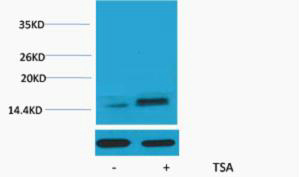
Main InformationTargetHistone H2A.ZHost SpeciesRabbitReactivityHuman, Mouse, RatApplicationsWBMW14kD (Observed)Conjugate/ModificationAcetylDetailed InformationRecommended Dilution RatioWB 1:500-1000FormulationPBS, pH 7.4, containing 0.5%BSA, 0.02% sodium azide as Preservative and 50% Glycerol.SpecificityThe antibody detects endogenous Histone H2A.Z (Acetyl Lys7) protein.PurificationThe antibody was affinity-purified from rabbit antiserum by affinity-chromatography using specific immunogen.Storage-15°C to -25°C/1 year(Do not lower than -25°C)MW(Observed)14kDModificationAcetylClonalityPolyclonalIsotypeIgGAntigen&Target InformationImmunogen:Synthetic Peptide of Histone H2A.Z (Acetyl Lys7)Specificity:The antibody detects endogenous Histone H2A.Z (Acetyl Lys7) protein.Gene Name:H2AFZProtein Name:Histone H2A.ZOther Name:H2AFZ ; H2AZ ; Histone H2A.Z ; H2A/zDatabase Link:Background:Histones are basic nuclear proteins that are responsible for the nucleosome structure of the chromosomal fiber in eukaryotes. Nucleosomes consist of approximately 146 bp of DNA wrapped around a histone octamer composed of pairs of each of the four core histones (H2A, H2B, H3, and H4). The chromatin fiber is further compacted through the interaction of a linker histone, H1, with the DNA between the nucleosomes to form higher order chromatin structures. This gene encodes a replication-independent member of the histone H2A family that is distinct from other members of the family. Studies in mice have shown that this particular histone is required for embryonic development and indicate that lack of functional histone H2A leads to embryonic lethality. [provided by RefSeq, Jul 2008],Function:Function:Variant histone H2A which replaces conventional H2A in a subset of nucleosomes. Nucleosomes wrap and compact DNA into chromatin, limiting DNA accessibility to the cellular machineries which require DNA as a template. Histones thereby play a central role in transcription regulation, DNA repair, DNA replication and chromosomal stability. DNA accessibility is regulated via a complex set of post-translational modifications of histones, also called histone code, and nucleosome remodeling. May be involved in the formation of constitutive heterochromatin. May be required for chromosome segregation during cell division.,mass spectrometry:Monoisotopic, not modified PubMed:16457589,PTM:Acetylated on Lys-5, Lys-8 and Lys-12 during interphase. Acetylation disappears at mitosis.,PTM:Monoubiquitination of Lys-122 gives a specific tag for epigenetic transcriptional repression.,PTM:Not phosphorylated.,similarity:Belongs to the histone H2A family.,subunit:The nucleosome is a histone octamer containing two molecules each of H2A, H2B, H3 and H4 assembled in one H3-H4 heterotetramer and two H2A-H2B heterodimers. The octamer wraps approximately 147 bp of DNA. H2A or its variant H2AFZ forms an heterodimer with H2B. H2AFZ interacts with INCENP.,Cellular Localization:Nucleus. Chromosome.Tissue Expression:Brain,Epithelium,Skeletal muscle,Uterus,Research Areas:>>Necroptosis ; >>Neutrophil extracellular trap formation ; >>Alcoholism ; >>Systemic lupus erythematosus
商品信息已成功复制,启研竭诚为您服务


