

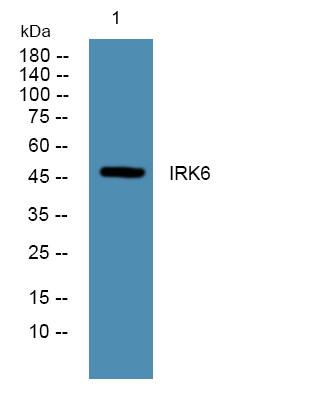
Main InformationTargetKIR3.2Host SpeciesRabbitReactivityHuman, Mouse, RatApplicationsIHC, IF, WBMW48kD (Observed)Conjugate/ModificationUnmodifiedDetailed InformationRecommended Dilution RatioIHC 1:50-200; WB 1:500-2000; IF 1:50-200FormulationLiquid in PBS containing 50% glycerol, 0.5% BSA and 0.02% sodium azide.SpecificityThis antibody detects endogenous levels of human KIR3.2PurificationThe antibody was affinity-purified from rabbit antiserum by affinity-chromatography using epitope-specific immunogen.Storage-15°C to -25°C/1 year(Do not lower than -25°C)Concentration1 mg/mlMW(Observed)48kDModificationUnmodifiedClonalityPolyclonalIsotypeIgGAntigen&Target InformationImmunogen:Synthesized peptide derived from human KIR3.2Specificity:This antibody detects endogenous levels of human KIR3.2Gene Name:KCNJ6 GIRK2 KATP2 KCNJ7Protein Name:KIR3.2Other Name:G protein-activated inward rectifier potassium channel 2 ; GIRK-2 ; BIR1 ; Inward rectifier K ; + ; channel Kir3.2 ; KATP-2 ; Potassium channel, inwardly rectifying subfamily J member 6 ;Background:This gene encodes a member of the G protein-coupled inwardly-rectifying potassium channel family of inward rectifier potassium channels. This type of potassium channel allows a greater flow of potassium into the cell than out of it. These proteins modulate many physiological processes, including heart rate in cardiac cells and circuit activity in neuronal cells, through G-protein coupled receptor stimulation. Mutations in this gene are associated with Keppen-Lubinsky Syndrome, a rare condition characterized by severe developmental delay, facial dysmorphism, and intellectual disability. [provided by RefSeq, Apr 2015],Function:Function:This potassium channel may be involved in the regulation of insulin secretion by glucose and/or neurotransmitters acting through G-protein-coupled receptors. Inward rectifier potassium channels are characterized by a greater tendency to allow potassium to flow into the cell rather than out of it. Their voltage dependence is regulated by the concentration of extracellular potassium; as external potassium is raised, the voltage range of the channel opening shifts to more positive voltages. The inward rectification is mainly due to the blockage of outward current by internal magnesium.,similarity:Belongs to the inward rectifier-type potassium channel family.,subunit:Associates with GIRK1 or GIRK4 to form a G-protein-activated heteromultimer pore-forming unit. The resulting inward current is much larger.,tissue specificity:Most abundant in cerebellum, and to a lesser degree in islets and exocrine pancreas.,Cellular Localization:Membrane; Multi-pass membrane protein.Tissue Expression:Most abundant in cerebellum, and to a lesser degree in islets and exocrine pancreas.Research Areas:>>Circadian entrainment ; >>Retrograde endocannabinoid signaling ; >>Cholinergic synapse ; >>Serotonergic synapse ; >>GABAergic synapse ; >>Dopaminergic synapse ; >>Estrogen signaling pathway ; >>Oxytocin signaling pathway ; >>GnRH secretion ; >>Morphine addiction
商品信息已成功复制,启研竭诚为您服务


