

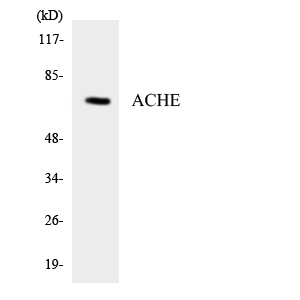
Main InformationTargetAChEHost SpeciesRabbitReactivityHuman, Mouse, RatApplicationsWB, ELISAMW70kD (Observed)Conjugate/ModificationUnmodifiedDetailed InformationRecommended Dilution RatioWB 1:500-1:2000; ELISA 1:5000; Not yet tested in other applications.FormulationLiquid in PBS containing 50% glycerol, 0.5% BSA and 0.02% sodium azide.SpecificityAChE Polyclonal Antibody detects endogenous levels of AChE protein.PurificationThe antibody was affinity-purified from rabbit antiserum by affinity-chromatography using epitope-specific immunogen.Storage-15°C to -25°C/1 year(Do not lower than -25°C)Concentration1 mg/mlMW(Observed)70kDModificationUnmodifiedClonalityPolyclonalIsotypeIgGAntigen&Target InformationImmunogen:The antiserum was produced against synthesized peptide derived from human ACHE. AA range:551-600Specificity:AChE Polyclonal Antibody detects endogenous levels of AChE protein.Gene Name:ACHEProtein Name:AcetylcholinesteraseOther Name:ACHE ; Acetylcholinesterase ; AChEBackground:Acetylcholinesterase hydrolyzes the neurotransmitter, acetylcholine at neuromuscular junctions and brain cholinergic synapses, and thus terminates signal transmission. It is also found on the red blood cell membranes, where it constitutes the Yt blood group antigen. Acetylcholinesterase exists in multiple molecular forms which possess similar catalytic properties, but differ in their oligomeric assembly and mode of cell attachment to the cell surface. It is encoded by the single ACHE gene, and the structural diversity in the gene products arises from alternative mRNA splicing, and post-translational associations of catalytic and structural subunits. The major form of acetylcholinesterase found in brain, muscle and other tissues is the hydrophilic species, which forms disulfide-linked oligomers with collagenous, or lipid-containing structural subunits. The other, alternativelyFunction:Catalytic activity:Acetylcholine + H(2)O = choline + acetate.,Disease:Behaves as an amyloid-promoting factor to promote the formation of amyloid plaques in Alzheimer disease.,Function:Terminates signal transduction at the neuromuscular junction by rapid hydrolysis of the acetylcholine released into the synaptic cleft. Role in neuronal apoptosis.,online information:Acetylcholinesterase entry,online information:Blood group antigen gene mutation database,polymorphism:ACHE is responsible for the Yt blood group system. The molecular basis of the Yt(a)=Yt1/Yt(b)=Yt2 blood group antigens is a single variation in position 353; His-353 corresponds to Yt(a) and the rare variant with Asn-353 to Yt(b).,similarity:Belongs to the type-B carboxylesterase/lipase family.,subcellular location:Only observed in apoptotic nuclei.,subunit:Interacts with PRIMA1. The interaction with PRIMA1 is required to anchor it to the basal lamina of cells and organize into tetramers (By similarity). Isoform H generates GPI-anchored dimers; disulfide linked. Isoform T generates multiple structures, ranging from monomers and dimers to collagen-tailed and hydrophobic-tailed forms, in which catalytic tetramers are associated with anchoring proteins that attach them to the basal lamina or to cell membranes. In the collagen-tailed forms, isoform T subunits are associated with a specific collagen, COLQ, which triggers the formation of isoform T tetramers, from monomers and dimers. Isoform R may be monomeric.,tissue specificity:Isoform H is highly expressed in erythrocytes.,Cellular Localization:Cell junction, synapse . Secreted . Cell membrane ; Peripheral membrane protein .; [Isoform T]: Nucleus. Only observed in apoptotic nuclei.; [Isoform H]: Cell membrane ; Lipid-anchor, GPI-anchor ; Extracellular side .Tissue Expression:Isoform H is highly expressed in erythrocytes.Research Areas:>>Glycerophospholipid metabolism ; >>Cholinergic synapse
商品信息已成功复制,启研竭诚为您服务


