

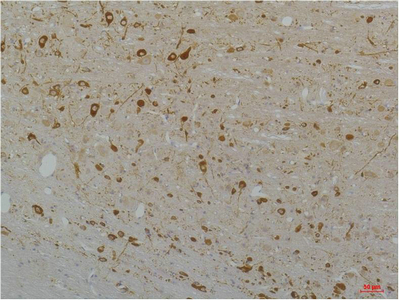
Main InformationTargetCav1.3Host SpeciesRabbitReactivityHuman, Rat, MouseApplicationsIHC, IFMW245kD (Observed)Conjugate/ModificationUnmodifiedDetailed InformationRecommended Dilution RatioIHC 1:100-200; IF 1:50-200FormulationLiquid in PBS containing 50% glycerol, 0.5% BSA and 0.02% sodium azide.SpecificityCav1.3 protein(A202) detects endogenous levels of Cav1.3PurificationThe antibody was affinity-purified from rabbit antiserum by affinity-chromatography using epitope-specific immunogen.Storage-15°C to -25°C/1 year(Do not lower than -25°C)Concentration1 mg/mlMW(Observed)245kDModificationUnmodifiedClonalityPolyclonalIsotypeIgGAntigen&Target InformationImmunogen:Synthetic Peptide of Cav1.3 AA range: 1060-1140Specificity:Cav1.3 protein(A202) detects endogenous levels of Cav1.3Gene Name:CACNA1DProtein Name:Voltage-dependent L-type calcium channel subunit alpha-1D (Calcium channel, L type, alpha-1 polypeptide, isoform 2) (Voltage-gated calcium channel subunit alpha Cav1.3)Other Name:Voltage-dependent L-type calcium channel subunit alpha-1D ; Calcium channel, L type, alpha-1 polypeptide, isoform 2 ; Voltage-gated calcium channel subunit alpha Cav1.3 ;Background:calcium voltage-gated channel subunit alpha1 D(CACNA1D) Homo sapiens Voltage-dependent calcium channels mediate the entry of calcium ions into excitable cells, and are also involved in a variety of calcium-dependent processes, including muscle contraction, hormone or neurotransmitter release, and gene expression. Calcium channels are multisubunit complexes composed of alpha-1, beta, alpha-2/delta, and gamma subunits. The channel activity is directed by the pore-forming alpha-1 subunit, whereas the others act as auxiliary subunits regulating this activity. The distinctive properties of the calcium channel types are related primarily to the expression of a variety of alpha-1 isoforms, namely alpha-1A, B, C, D, E, and S. This gene encodes the alpha-1D subunit. Several transcript variants encoding different isoforms have been found for this gene. [provided by RefSeq, Dec 2012],Function:Alternative products:Additional isoforms seem to exist,Domain:Each of the four internal repeats contains five hydrophobic transmembrane segments (S1, S2, S3, S5, S6) and one positively charged transmembrane segment (S4). S4 segments probably represent the voltage-sensor and are characterized by a series of positively charged amino acids at every third position.,Function:Voltage-sensitive calcium channels (VSCC) mediate the entry of calcium ions into excitable cells and are also involved in a variety of calcium-dependent processes, including muscle contraction, hormone or neurotransmitter release, gene expression, cell motility, cell division and cell death. The isoform alpha-1D gives rise to L-type calcium currents. Long-lasting (L-type) calcium channels belong to the 'high-voltage activated' (HVA) group. They are blocked by dihydropyridines (DHP), phenylalkylamines, benzothiazepines, and by omega-agatoxin-IIIA (omega-Aga-IIIA). They are however insensitive to omega-conotoxin-GVIA (omega-CTx-GVIA) and omega-agatoxin-IVA (omega-Aga-IVA).,polymorphism:A change from seven to eight ATG trinucleotide repeats, resulting in an additional N-terminal methionine, has been found in a patient with non-insulin-dependent diabetes mellitus (NIDDM).,similarity:Belongs to the calcium channel alpha-1 subunit (TC 1.A.1.11) family.,subunit:Voltage-dependent calcium channels are multisubunit complexes, consisting of alpha-1, alpha-2, beta and delta subunits in a 1:1:1:1 ratio. The channel activity is directed by the pore-forming and voltage-sensitive alpha-1 subunit. In many cases, this subunit is sufficient to generate voltage-sensitive calcium channel activity. The auxiliary subunits beta and alpha-2/delta linked by a disulfide bridge regulate the channel activity. Interacts with RIMBP2.,tissue specificity:Expressed in pancreatic islets and in brain, where it has been seen in hippocampus, basal ganglia, habenula and thalamus. No expression in skeletal muscle.,Cellular Localization:Membrane ; Multi-pass membrane protein .Tissue Expression:Expressed in pancreatic islets and in brain, where it has been seen in cerebral cortex, hippocampus, basal ganglia, habenula and thalamus. Expressed in the small cell lung carcinoma cell line SCC-9. No expression in skeletal muscle.Research Areas:>>MAPK signaling pathway ; >>Calcium signaling pathway ; >>cGMP-PKG signaling pathway ; >>cAMP signaling pathway ; >>Cellular senescence ; >>Cardiac muscle contraction ; >>Adrenergic signaling in cardiomyocytes ; >>Vascular smooth muscle contraction ; >>Tight junction ; >>Circadian entrainment ; >>Retrograde endocannabinoid signaling ; >>Glutamatergic synapse ; >>Cholinergic synapse ; >>Serotonergic synapse ; >>GABAergic synapse ; >>Dopaminergic synapse ; >>Insulin secretion ; >>GnRH signaling pathway ; >>Oxytocin signaling pathway ; >>Renin secretion ; >>Aldosterone synthesis and secretion ; >>Cortisol synthesis and secretion ; >>GnRH secretion ; >>Type II diabetes mellitus ; >>Cushing syndrome ; >>Growth hormone synthesis, secretion and action ; >>Carbohydrate digestion and absorption ; >>Alzheimer disease ; >>Prion disease ; >>Pathways of neurodegeneration - multiple diseases ; >>Amphetamine addiction ; >>Chemical carcinogenesis - receptor activation ; >>Hypertrophic cardiomyopathy ; >>Arrhythmogenic right ventricular cardiomyopathy ; >>Dilated cardiomyopathy
商品信息已成功复制,启研竭诚为您服务


