

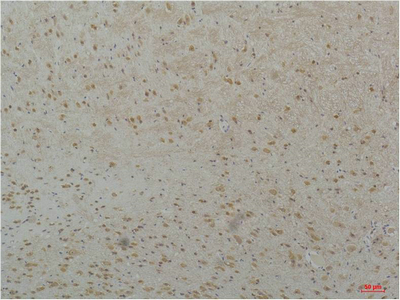
Main InformationTargetCav3.2Host SpeciesRabbitReactivityHuman, Rat, MouseApplicationsIHC, IFMW260kD (Observed)Conjugate/ModificationUnmodifiedDetailed InformationRecommended Dilution RatioIHC 1:50-100; IF 1:50-200FormulationLiquid in PBS containing 50% glycerol, 0.5% BSA and 0.02% sodium azide.SpecificityCav3.2 protein(A208) detects endogenous levels of Cav3.2PurificationThe antibody was affinity-purified from rabbit antiserum by affinity-chromatography using epitope-specific immunogen.Storage-15°C to -25°C/1 year(Do not lower than -25°C)Concentration1 mg/mlMW(Observed)260kDModificationUnmodifiedClonalityPolyclonalIsotypeIgGAntigen&Target InformationImmunogen:Synthetic Peptide of Cav3.2 AA range: 1718-1768Specificity:Cav3.2 protein(A208) detects endogenous levels of Cav3.2Gene Name:CACNA1HProtein Name:Voltage-dependent T-type calcium channel subunit alpha-1H (Low-voltage-activated calcium channel alpha1 3.2 subunit) (Voltage-gated calcium channel subunit alpha Cav3.2)Other Name:CACNA1H ; Voltage-dependent T-type calcium channel subunit alpha-1H ; Low-voltage-activated calcium channel alpha1 3.2 subunit ; Voltage-gated calcium channel subunit alpha Cav3.2Background:calcium voltage-gated channel subunit alpha1 H(CACNA1H) Homo sapiens This gene encodes a T-type member of the alpha-1 subunit family, a protein in the voltage-dependent calcium channel complex. Calcium channels mediate the influx of calcium ions into the cell upon membrane polarization and consist of a complex of alpha-1, alpha-2/delta, beta, and gamma subunits in a 1:1:1:1 ratio. The alpha-1 subunit has 24 transmembrane segments and forms the pore through which ions pass into the cell. There are multiple isoforms of each of the proteins in the complex, either encoded by different genes or the result of alternative splicing of transcripts. Alternate transcriptional splice variants, encoding different isoforms, have been characterized for the gene described here. Studies suggest certain mutations in this gene lead to childhood absence epilepsy (CAE). [provided by RefSeq, Jul 2008],Function:Disease:Defects in CACNA1H are a cause of susceptibility to idiopathic generalized epilepsy type 6 (IGE6) [MIM:611942]. IGE is characterized by recurring generalized seizures in the absence of detectable brain lesions and/or metabolic abnormalities. Generalized seizures arise diffusely and simultaneously from both hemispheres of the brain. IGE6 is a polygenic and multifactorial disease.,Domain:Each of the four internal repeats contains five hydrophobic transmembrane segments (S1, S2, S3, S5, S6) and one positively charged transmembrane segment (S4). S4 segments probably represent the voltage-sensor and are characterized by a series of positively charged amino acids at every third position.,Function:Voltage-sensitive calcium channels (VSCC) mediate the entry of calcium ions into excitable cells and are also involved in a variety of calcium-dependent processes, including muscle contraction, hormone or neurotransmitter release, gene expression, cell motility, cell division and cell death. The isoform alpha-1H gives rise to T-type calcium currents. T-type calcium channels belong to the "low-voltage activated (LVA)" group and are strongly blocked by nickel and mibefradil. A particularity of this type of channels is an opening at quite negative potentials, and a voltage-dependent inactivation. T-type channels serve pacemaking functions in both central neurons and cardiac nodal cells and support calcium signaling in secretory cells and vascular smooth muscle. They may also be involved in the modulation of firing patterns of neurons which is important for information processing as well as in cell growth processes.,PTM:In response to raising of intracellular calcium, the T-type channels are activated by CaM-kinase II.,similarity:Belongs to the calcium channel alpha-1 subunit (TC 1.A.1.11) family.,tissue specificity:Expressed in kidney, liver, heart, brain. Isoform 2 seems to be testis-specific.,Cellular Localization:Cell membrane ; Multi-pass membrane protein . Interaction with STAC increases expression at the cell membrane. .Tissue Expression:Expressed in the adrenal glomerulosa (at protein level) (PubMed:25907736, PubMed:27729216). In nonneuronal tissues, the highest expression levels are found in the kidney, liver, and heart. In the brain, most abundant in the amygdala, caudate nucleus, and putamen (PubMed:9670923, PubMed:9930755). In the heart, expressed in blood vessels. ; [Isoform 1]: Expressed in testis, primarily in the germ cells, but not in other portions of the reproductive tract, such as ductus deferens (PubMed:11751928). Expressed in the brain (PubMed:11751928). ; [Isoform 2]: Expressed in testis, primarily in the germ cells, but not in other portions of the reproductive tract, such as ductus deferens (PubMed:11751928). Not expressed in the brain (PubMed:11751928).Research Areas:>>MAPK signaling pathway ; >>Calcium signaling pathway ; >>Circadian entrainment ; >>Aldosterone synthesis and secretion ; >>Cortisol synthesis and secretion ; >>GnRH secretion ; >>Cushing syndrome
商品信息已成功复制,启研竭诚为您服务


