

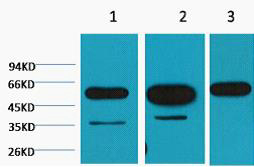
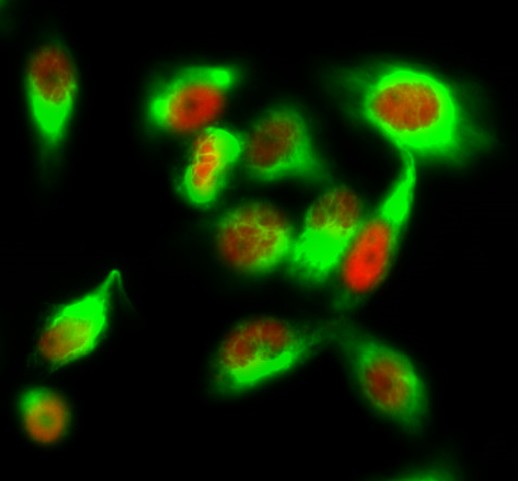
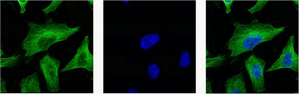
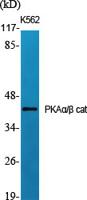
Main InformationTargetTubulin βHost SpeciesMouseReactivityHuman, Mouse, RatApplicationsWB, IFMW55kD (Observed)Conjugate/ModificationUnmodifiedDetailed InformationRecommended Dilution RatioWB 1:5000 -10000; IF 1:100-200FormulationPBS, pH 7.4, containing 0.5%BSA, 0.02% sodium azide as Preservative and 50% Glycerol.SpecificityThe antibody detects endogenousβ-tubulin protein.PurificationThe antibody was affinity-purified from mouse ascites by affinity-chromatography using specific immunogen.Storage-15°C to -25°C/1 year(Do not lower than -25°C)Concentration1 mg/mlMW(Observed)55kDModificationUnmodifiedClonalityMonoclonalClone NumberM7Antigen&Target InformationImmunogen:Synthetic Peptide of β-tubulinSpecificity:The antibody detects endogenousβ-tubulin protein.Gene Name:TUBB3Protein Name:Tubulin beta-3 chainOther Name:TUBB3 ; TUBB4 ; Tubulin beta-3 chain ; Tubulin beta-4 chain ; Tubulin beta-IIIDatabase Link:Background:tubulin beta 3 class III(TUBB3) Homo sapiens This gene encodes a class III member of the beta tubulin protein family. Beta tubulins are one of two core protein families (alpha and beta tubulins) that heterodimerize and assemble to form microtubules. This protein is primarily expressed in neurons and may be involved in neurogenesis and axon guidance and maintenance. Mutations in this gene are the cause of congenital fibrosis of the extraocular muscles type 3. Alternate splicing results in multiple transcript variants. A pseudogene of this gene is found on chromosome 6. [provided by RefSeq, Oct 2010],Function:Domain:The highly acidic C-terminal region may bind cations such as calcium.,Function:Receptor for MSH (alpha, beta and gamma) and ACTH. The activity of this receptor is mediated by G proteins which activate adenylate cyclase.,Function:Tubulin is the major constituent of microtubules. It binds two moles of GTP, one at an exchangeable site on the beta chain and one at a non-exchangeable site on the alpha-chain.,polymorphism:Genetic variations in MC1R are associated with variation in skin/hair/eye pigmentation type 2 (SHEP2) [MIM:266300]. Hair, eye and skin pigmentation are among the most visible examples of human phenotypic variation, with a broad normal range that is subject to substantial geographic stratification. In the case of skin, individuals tend to have lighter pigmentation with increasing distance from the equator. By contrast, the majority of variation in human eye and hair color is found among individuals of European ancestry, with most other human populations fixed for brown eyes and black hair.,polymorphism:Variations in MC1R are linked to the degree of skin pigmentation (Types I-IV). Type I skin the most lightly pigmented and type IV the most dark pigmented. Partial loss-of-function mutations are associated with fair skin, poor tanning and increased skin cancer risk.,similarity:Belongs to the G-protein coupled receptor 1 family.,similarity:Belongs to the tubulin family.,subunit:Dimer of alpha and beta chains.,tissue specificity:Melanocytes and corticoadrenal tissue.,Cellular Localization:Cytoplasm, cytoskeleton . Cell projection, growth cone . Cell projection, lamellipodium . Cell projection, filopodium .Tissue Expression:Expression is primarily restricted to central and peripheral nervous system. Greatly increased expression in most cancerous tissues.Research Areas:>>Phagosome ; >>Gap junction ; >>Alzheimer disease ; >>Parkinson disease ; >>Amyotrophic lateral sclerosis ; >>Huntington disease ; >>Prion disease ; >>Pathways of neurodegeneration - multiple diseases ; >>Pathogenic Escherichia coli infection ; >>Salmonella infection
商品信息已成功复制,启研竭诚为您服务


